

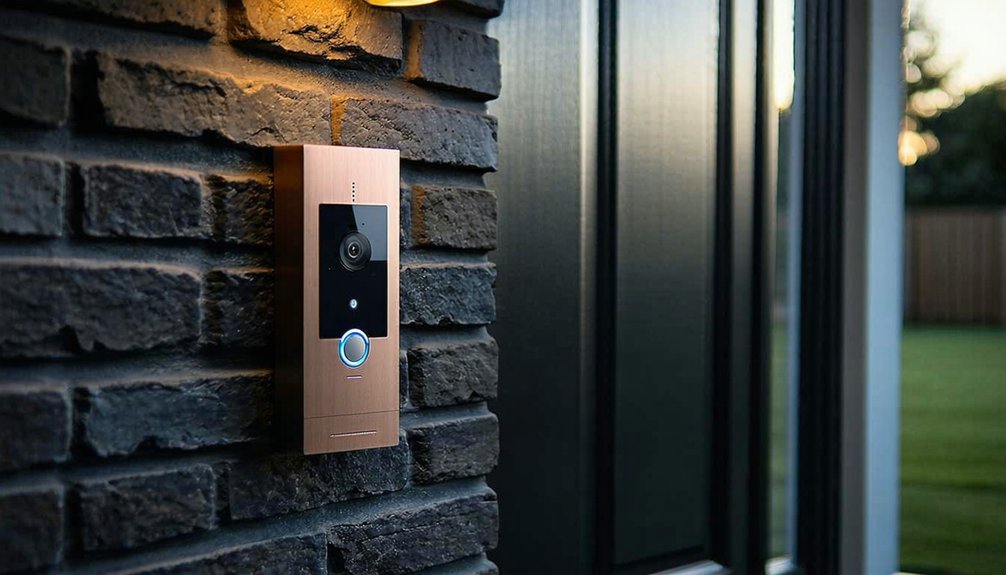

The best video doorbells balance resolution, power type, detection accuracy, and long-term storage costs. Top-tier picks like the Eufy E340 deliver dual-camera coverage and subscription-free local storage, while options like the Ring Wired Doorbell Pro offer 4K clarity for wired homes. Budget models such as the Blink Video Doorbell provide reliable 1080p performance under $60. Matching the right doorbell to a household’s ecosystem, wiring, and budget separates a smart investment from a costly compromise—and the details make all the difference.
Key Takeaways
- Wired doorbells offer uninterrupted recording and low maintenance, while battery models provide flexible placement ideal for renters without existing wiring.
- Resolution matters: budget models deliver 1080p, mid-range offer 2K, and premium options like Ring Wired Doorbell Pro reach 4K for sharper detail.
- Subscription-free models from Eufy, Lorex, and Wyze use local storage, avoiding recurring fees that can push five-year costs toward $400.
- Advanced AI features like facial recognition, package detection, and activity zones enhance security but may require paid subscriptions to unlock fully.
- Dual-camera designs, HDR processing, and wide vertical FOVs ensure complete visibility of visitors and ground-level packages day and night.
Resolution, Power Type, and Subscription Costs: What Actually Matters
Choosing a video doorbell in 2026 means steering through a resolution landscape that has shifted meaningfully upward, with mid-range models now commonly shipping at 2K (~1440p) and premium options such as the Ring Wired Doorbell Pro (3rd Gen) reaching 4K at roughly $250. Budget models around $50–$100 retain 1080p, trading detail for lower cost and reduced storage demand.
Resolution alone, however, does not determine image quality—sensor performance, lens sharpness, HDR processing, and low-light capability collectively shape usable footage. Higher resolution also introduces practical trade-offs: larger files strain cloud storage allotments and increase upload bandwidth demands.
Shoppers prioritizing ongoing savings should evaluate local-storage models from brands like Eufy or TP-Link Tapo, which absorb 2K recording costs without recurring subscription fees, making total ownership cost competitive over time. A $100 doorbell paired with a $5 monthly subscription reaches a $400 five-year total, while a $200 no-subscription model stays at its purchase price.
Should You Go Wired or Battery-Powered?
The decision between wired and battery-powered video doorbells shapes nearly every practical aspect of ownership, from installation day through years of daily use.
Wired models deliver continuous power, uninterrupted recording capability, and liberation from recurring maintenance — advantages that compound meaningfully in high-traffic settings where reliability defines peace of mind.
Battery-powered doorbells, by contrast, offer placement flexibility that wired installations simply cannot match, making them the practical choice for renters, unconventional entry points, and homes without existing low-voltage wiring.
Hybrid and plug-in configurations occupy a practical middle ground, preserving much of wired power’s consistency without demanding a dedicated doorbell circuit.
Ultimately, the right choice aligns with how a home is built, how it is lived in, and how much ongoing maintenance its owners are willing to absorb. Most wired video doorbells require a transformer to convert home power to the correct voltage before it reaches the doorbell itself.
Best Overall Video Doorbell: Eufy E340
Among a crowded field of video doorbells, the Eufy E340 distinguishes itself through a dual-camera architecture that addresses two persistent gaps in conventional doorbell design: reliable visitor identification and dedicated package monitoring. A 2K front lens captures faces across a 160° field of view, while a downward-facing 1080p camera watches deliveries at ground level — both feeds viewable simultaneously within a single app interface.
The combination of PIR and radar sensors claims a 95% reduction in false alerts, while on-device AI distinguishes people from packages without requiring a subscription. An 8 GB local storage chip and 6,500 mAh battery reinforce Eufy’s positioning around ownership and privacy. For households seeking thorough doorstep coverage without recurring fees, the E340 represents a considered, capable choice. Setup is straightforward, with the doorbell clipping into a mounted bracket and a positioning card included to assist with optimal angle alignment.
Best Budget Video Doorbell: Blink Video Doorbell
At roughly $59.99, the Blink Video Doorbell occupies a category where most competitors demand either a premium price or a recurring subscription — and it largely sidesteps both. Recognized by The Independent and The Guardian as the leading budget option, it delivers 1080p HD video, infrared night vision, motion-activated alerts, and two-way audio without the financial commitment rivals require.
Power flexibility stands out: two AA lithium batteries support up to two years of operation, while hardwiring remains available for those preferring it. Local storage via Sync Module 2 and a USB drive eliminates mandatory cloud fees entirely. Alexa integration adds live-view capability on Echo Show and Fire TV devices. For essential doorstep security at a considered price, the Blink rarely concedes ground.
Those seeking cloud storage instead will find Blink’s subscription among the most affordable in the industry, with plans starting at $3.99 per month for a single device.
Best Subscription-Free Video Doorbell: Eufy C210
Few video doorbells resolve the subscription dilemma as cleanly as the Eufy C210. Where cloud-dependent competitors quietly accumulate monthly fees, the C210 stores footage locally on its bundled Wi-Fi chime, keeping recordings private and costs predictable.
Its 1080p Full HD resolution, WDR processing, and day-and-night video tuning deliver reliable clarity without premium pricing. AI human detection filters cars and foliage, ensuring alerts remain meaningful rather than overwhelming.
Two-way audio and instant push notifications through the eufy Security app maintain seamless visitor communication remotely. Battery life reaches an advertised 120 days under typical use, and wire-free installation suits virtually any doorframe.
For homeowners seeking capable, long-term security without recurring subscription obligations, the C210 represents a principled, cost-effective choice. Unlike some models that rely solely on the cloud, the C210 retains access to local storage even during Wi-Fi outages.
Best Video Doorbell for Apple HomeKit: Aqara G410
Subscription-free local storage suits many homeowners well, but those embedded in the Apple ecosystem have a different priority: seamless, native integration across iPhone, iPad, Apple Watch, and Apple TV. The Aqara G410 delivers precisely that.
It appears natively in the Apple Home app as a standard doorbell camera, supports HomeKit Secure Video for encrypted iCloud+ recording with activity zones and face recognition, and offers dual-band Wi-Fi plus an onboard 2K sensor for sharper local viewing.
A millimeter-wave radar sensor and on-device AI guarantees precise human detection without excessive cloud dependency.
Battery or hardwired installation options accommodate most homes, while the included indoor chime hub doubles as a smart home hub. For Apple households, the G410 represents a thoughtfully engineered, ecosystem-first choice. RTSP streaming is also available for wired installations, allowing the G410 to be imported as a generic camera for additional integration flexibility.
Best AI Detection: SwannBuddy 4K
For homeowners who want their doorbell to do more than record, the SwannBuddy 4K introduces a genuinely different proposition: an AI-powered device capable of holding a real conversation with whoever rings it.
The SwannShield generative AI voice assistant engages visitors naturally, handling deliveries, guest verification, and deterrence autonomously using a realistic Australian accent generated live rather than from pre-recorded clips.
Hardware reinforces the intelligence.
A 4K UHD sensor, 165° vertical field of view, and True Detect heat-sensing PIR together provide the quality inputs that make AI analytics reliable.
Subscription tiers enable object classification for people, pets, vehicles, and packages, elevating detection well beyond standard motion alerts.
Dual local and cloud recording ensures footage redundancy. The included 32GB microSD card enables local storage without requiring a cloud subscription or forced upload of footage.
PCWorld and PCMag both recognise the AI voice feature as a meaningful differentiator in the mid-range segment.
Best Video Doorbell for Google Home: Google Nest Doorbell
Homeowners already embedded in the Google ecosystem have little reason to look elsewhere: the Google Nest Doorbell is purpose-built for exactly that environment. Live video streams directly to Nest Hub displays, Chromecast devices, and Google Assistant smart TVs, while doorbell presses trigger spoken announcements through Nest speakers — no third-party workarounds required. Its vertical 3:4 HD resolution captures visitors head-to-toe alongside ground-level packages, and on-device intelligence distinguishes people, animals, and vehicles from irrelevant motion. Familiar Face Detection, Activity Zones, and Quick Responses refine the experience further with a Nest Aware subscription. Available in both battery and wired configurations, installation adapts to virtually any entryway. The wired model delivers 2K HDR video for rich color and detailed images in both day and night conditions. AndroidCentral, Wirecutter, and PCMag consistently recognize it as the definitive video doorbell for Google Home households — a reputation well earned.
Ring Battery Doorbell Plus vs. Ring Wired Doorbell Pro
Ring’s two mid-range doorbells occupy distinct positions in the lineup: the Battery Doorbell Plus at roughly $179.99 suits renters, first-time buyers, and anyone without existing doorbell wiring, while the Wired Doorbell Pro at $249.99 targets homeowners willing to invest more upfront for Retinal 4K resolution, Audio+ hardware, and the consistent performance that comes with continuous wired power.
The Battery Doorbell Plus still delivers 1536p HD+ video with head-to-toe framing and package detection, making it a genuinely capable choice at a friendlier price point. The Wired Doorbell Pro, however, raises the ceiling with sharper detail, superior 10× zoom, and faster response times. Both require a Ring Protect subscription for cloud recording. The deciding factor ultimately comes down to wiring availability, budget, and how much video clarity matters. Both models also support radar-powered 3D Motion Detection, giving wired users a more precise and responsive way to monitor activity outside their front door.
Which Video Doorbell Is Right for Your Home?
Choosing the right video doorbell ultimately comes down to five practical variables: power source, video performance, detection capability, storage model, and long-term cost.
Renters and apartment dwellers gravitate toward battery-powered options like the TP-Link Tapo 225 or Blink Video Doorbell, while homeowners with existing chime wiring open up broader hardwired possibilities.
Those prioritizing clarity benefit from 2K or 4K models, particularly where low-light and package detection matter.
AI-driven classification, wide vertical fields of view, and HDR support further separate premium picks from entry-level alternatives.
On cost, subscription-free models from Eufy, Lorex, and Wyze offer local storage without recurring fees, whereas cloud-dependent platforms deliver richer event histories.
Matching each variable to household needs guarantees a confident, well-informed selection. The Aqara G410 stands out for Apple users by acting as a Matter hub and Thread signal repeater while keeping controls within the Apple Home app.
In Conclusion
Choosing the right video doorbell ultimately comes down to individual priorities — budget, smart home compatibility, and whether a subscription model is acceptable. Each option reviewed serves a distinct type of homeowner, from the feature-rich Eufy E340 to the no-frills Blink. Those willing to invest in premium hardware will find lasting value, while budget-conscious buyers need not sacrifice meaningful security. The ideal doorbell is simply the one that fits seamlessly into an existing lifestyle and home setup.
References
- https://www.independent.co.uk/extras/indybest/gadgets-tech/best-video-doorbell-camera-uk-b1806100.html
- https://www.nytimes.com/wirecutter/reviews/best-smart-doorbell-camera/
- https://www.youtube.com/watch?v=5LkvfhUeBrY&vl=en
- https://www.youtube.com/watch?v=sTe9xDYniZ0&vl=en
- https://www.reddit.com/r/homeassistant/comments/1qg9vzk/best_doorbell_camera_for_the_money_in_2026/
- https://www.youtube.com/watch?v=8q693tm-Pyk
- https://goabode.com/blog/best-doorbell-camera-no-subscription/
- https://www.wired.com/gallery/best-video-doorbells/
- https://www.consumerreports.org/home-garden/home-security-cameras/best-video-doorbells-of-the-year-a1115426074/
- https://www.pcmag.com/picks/the-best-video-doorbells