

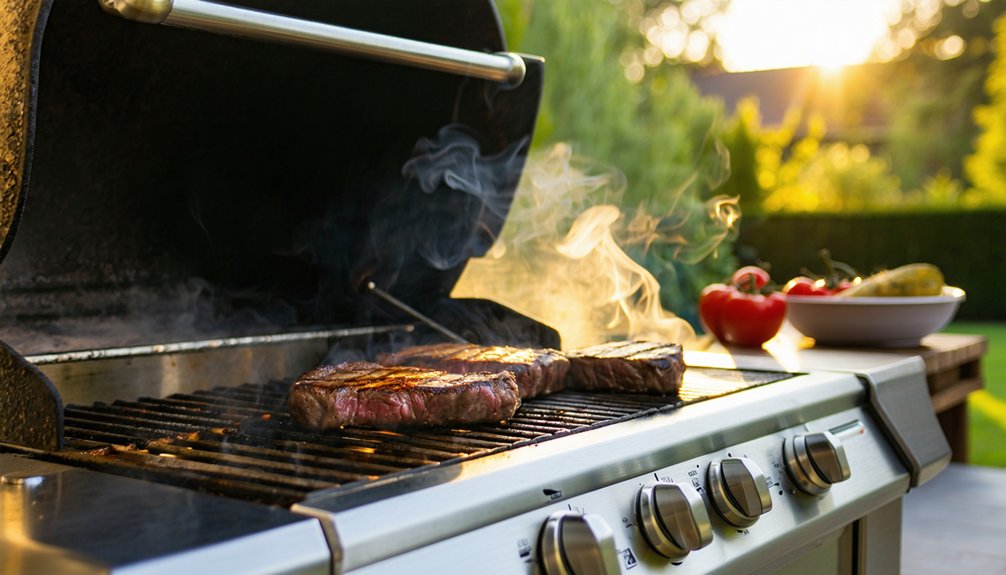

Experts consistently return to the same ten grills when ranking models worth a permanent outdoor setup. The Weber Genesis S-435 and Kamado Joe Classic III lead across gas and charcoal categories, while Traeger and Yoder dominate pellet performance. Compact electric options like the Weber Lumin suit balcony restrictions without sacrificing sear capability. Testing methodology, material quality, and sustained temperature performance separate genuine contenders from forgettable units. Every ranked model earns its place for a reason worth knowing.
Key Takeaways
- Weber Genesis S-435 and Weber Genesis Smart EX-325W are named best overall gas grills by NBC Select and Good Housekeeping respectively.
- Kamado Joe Classic III and Big Green Egg offer unmatched versatility, functioning as smokers, ovens, and grills across 225°F to 750°F.
- Traeger Westwood and Yoder YS480S lead pellet grill rankings for precise temperature control and heavy-duty construction.
- Weber Spirit E-310 and Spirit E-435 consistently rank among top value gas grills across multiple expert publications.
- Compact options like Weber Q1200 and Weber Traveler deliver full-performance grilling for small patios and storage-conscious users.
Best Overall Gas Grills Experts Keep Recommending
When expert testers across major publications converge on the same brand repeatedly, the pattern is difficult to ignore. Weber’s Genesis and Spirit series dominate best-overall rankings across trusted outlets, and for good reason.
NBC Select editors designated the Genesis S-435 their best overall gas grill, while Good Housekeeping’s lab-tested 2026 guide awarded that distinction to the Genesis Smart EX-325W — positioning it above gas, charcoal, and kamado competitors alike.
The Spirit line earns equal confidence: Yahoo Life selected the Spirit E-310 after testing more than 15 grills, and Business Insider named the Spirit E-435 its best overall pick. Across price points, formats, and publication standards, Weber consistently occupies the top slot — a signal serious grill buyers recognize.
Gas grills remain the dominant choice among backyard cooks, with an estimated 63% of grill owners opting for gas over charcoal or other fuel types.
Best Charcoal Grills for Flavor You Can’t Fake
Charcoal grills occupy a category defined by a single uncompromising standard: the flavor that gas, electric, and pellet alternatives cannot replicate. The Weber Original Kettle Premium 22-inch consistently earns best-overall recognition for its dual dampers, tight-fitting lid, and two-zone fire capability. Napoleon’s 22-inch Kettle rivals it with cast-iron grates and precision airflow control, earning comparable top rankings in Forbes testing.
Both deep-bowl kettle designs recirculate smoke around food in ways Wirecutter and Gear Patrol identify as central to authentic charcoal character. For those pursuing heavier bark and pronounced smoke rings, barrel-style units from Royal Gourmet and offset configurations from Oklahoma Joe’s introduce larger coal beds and side fireboxes that channel clean smoke across extended cook times. The Dyna-Glo Heavy-Duty Charcoal Grill expands on that capacity with 816 square inches of cooking surface, accommodating approximately 36 burgers at once for those regularly feeding a crowd.
Best Kamado Grills for Serious Heat and Versatility
Kamado grills occupy a distinct tier among live-fire cookers, combining thick ceramic or insulated steel construction with precision airflow control to span temperature ranges most other grill types cannot match.
The Kamado Joe Classic III consistently earns best-overall recognition, delivering 225°F low-and-slow performance through 750°F searing capability, supported by the SloRoller insert and Divide & Conquer multi-level cooking system.
The Big Green Egg Large remains the category benchmark, backed by an unmatched accessory ecosystem spanning pizza stones, rotisserie kits, and baking setups.
For rapid preheat and fuel efficiency, the Weber Summit Kamado reaches searing temperatures within 15–20 minutes.
Across all three, a single lump charcoal load sustains 12–18-hour smoking sessions, confirming that serious versatility and serious heat are never mutually exclusive. Kamado grills function equally well as smokers, ovens, and charcoal grills, making them among the most versatile live-fire cookers available to outdoor cooks today.
Best Pellet Grills for Low-and-Slow Cooking
Pellet grills have earned a firm place in low-and-slow barbecue by automating the most demanding aspect of the craft: temperature consistency. PID controllers, insulated construction, and large hoppers separate serious contenders from lesser machines.
The Traeger Westwood leads current expert rankings, praised for precise temperature control and modern connectivity suited to overnight cooks. The Yoder YS480S and YS640S attract experienced pitmasters seeking heavy construction and exceptional smoke production. Camp Chef’s Woodwind series earns consistent recommendations for its ash clean-out system and smoke-boost settings.
For budget-conscious buyers, the Z Grills 700D-series and Camp Chef SmokePro DLX deliver reliable 225–275°F performance without significant compromise. Across all price points, hopper capacity, temperature range, and build quality remain the defining selection criteria. The choice of hardwood pellets, whether hickory, mesquite, or apple, significantly influences flavor and should be considered alongside hardware when selecting a setup.
Best Smoker-Grill Combos That Do Both Jobs Well
Smoker-grill combos resolve a persistent tension in outdoor cooking: the desire for both high-heat grilling performance and patient, smoke-driven barbecue without dedicating separate units to each task. Oklahoma Joe’s Longhorn Charcoal/Gas Combo exemplifies this balance, pairing 36,000 BTU gas burners with a dedicated offset firebox, allowing simultaneous grilling at 400–500°F and smoking at 225–275°F.
Traditional barrel-style offset combos like Royal Gourmet’s charcoal designs deliver 600–800+ square inches of cook space, accommodating multiple racks of ribs alongside seared steaks.
Vertical charcoal combos such as the Realcook offer a compact alternative, with stackable grates and a built-in water pan for moisture-stable long cooks. Each category rewards the cook who refuses compromise, consolidating serious capability within a single, purposeful footprint. The Dyna-Glo Signature Series expands that capability further with 1,382 square inches of cooking surface spread across five racks and sausage hooks for whole-muscle and link smoking in a single session.
Best Compact and Portable Grills for Tight Spaces
Across a spectrum of fuels and form factors, compact and portable grills have matured into a serious product category, answering the practical demands of balcony cooks, frequent travelers, and space-constrained households without meaningful sacrifice in performance.
The Weber Spirit II E-210 anchors the small-patio gas category with 26,500 BTU output and fold-down side tables. The Weber Q1200 delivers reliable tabletop propane performance in a rust-resistant cast-aluminum shell. For storage-conscious users needing a full-size cooking surface, the Weber Traveler’s foldable cart design earns consistent top rankings.
Charcoal devotees turn to the Weber Smokey Joe’s 14-inch kettle or the Everdure Cube’s heat-resistant rectangular form. Each model reflects a deliberate engineering trade-off between portability and capability — a balance today’s leading compact grills increasingly manage to strike. The Solaire Anywhere Portable Infrared delivers 14,000 BTU output in a 20-pound marine steel shell, making it one of the most heat-dense options available in a compact form factor.
Best Electric Grills for Balconies and Small Patios
Electric grills have steadily emerged as the default solution for balcony and small-patio cooking, where charcoal and propane are routinely prohibited by lease agreements, condominium bylaws, and municipal fire codes. Fully electric, no-open-flame designs satisfy most compliance requirements while eliminating flare-up risk and dangerous emissions in confined spaces.
Experts consistently recommend models delivering 1,500–2,400 watts, infrared heating technology for even heat distribution, and approximately five adjustable temperature settings to accommodate everything from delicate fish to thick cuts. Cooking surfaces between 150 and 250 square inches suit most small balconies, while lightweight tabletop designs with removable stands offer flexible placement.
Removable non-stick grates, dishwasher-safe drip trays, and enclosed heating elements round out the features that distinguish genuinely balcony-appropriate grills from those merely marketed as compact. The Weber Lumin stands out among compact options by reaching temperatures above 600°F, outperforming the typical electric grill ceiling of around 500°F for genuine searing results.
Best Budget Grills That Deliver Real Performance
Despite common assumptions that performance begins where budget ends, the sub-$500 gas and charcoal grill market has matured into a genuinely competitive space where careful material selection, burner engineering, and heat management separate standout models from disposable ones.
Gas grills under $300 routinely deliver 30,000–40,000 BTU across three to four burners, porcelain-enameled grates, and heat diffusers that minimize uneven cooking.
Stepping into the $300–$500 range rewards buyers with heavier lids, extended burner warranties, and preheat speeds reaching 500°F within fifteen minutes.
Budget charcoal options make an equally compelling case, with porcelain-enameled firebowls, adjustable vents, and tight-fitting lids supporting both direct searing and indirect roasting.
Across all three categories, informed selection consistently yields results that rival grills priced markedly higher. Standout budget models such as the Weber Original Kettle, Char-Broil Performance 300, and Dyna-Glo DGB390SNP-D demonstrate that value and performance can reliably coexist without forcing buyers to compromise on durability or cooking quality.
Best Premium Grills Worth the Splurge
Budget grills have closed the performance gap considerably, yet a ceiling remains—one that premium grills are engineered to push past entirely. Built from 304 stainless steel with heavy-duty burners, thicker grates, and precision-fitted construction, premium models occupy a tier where materials and performance converge meaningfully.
Independent temperature zones allow simultaneous searing and roasting, while rotisserie systems and integrated sear burners expand what’s possible without compromise. Heat distribution is more consistent, ignition more reliable, and longevity far greater than budget counterparts.
Many luxury units function as anchors for fully realized outdoor kitchens, where the grill becomes architecture as much as appliance. For those investing at the $4,000–$8,000 level and beyond, the expectation shifts—from cooking outdoors to cooking seriously, with equipment that reflects exactly that standard. Premium models frequently include lifetime warranties covering stainless components, a reflection of the manufacturer’s confidence in the materials used.
How Experts Test Grills Before Naming a Winner
Naming a winning grill requires more than casual opinion—it demands a structured testing methodology built on objective measurement and repeatable conditions. Experts deploy calibrated thermocouple probes and data-logging software to map heat distribution, track preheat curves, and identify hot or cold zones across the cooking surface. Standardized fuel configurations, fixed vent positions, and consistent lid protocols guarantee results remain comparable across models.
Real-world performance is assessed through controlled cooks—burgers, ribs, whole chickens in the 5.5–6 lb range—evaluated on sear quality, smoke character, and safe internal temperatures. Low-and-slow capability is verified by sustaining 225°F for several hours.
Construction integrity, usable cooking area, and assembly clarity round out the evaluation, assure every recommended grill earns its place through evidence, not assumption. Grills are also assessed for heat transfer to exterior surfaces, identifying burn risks and verifying whether handles marketed as keep-cool actually remain safe to the touch during use.
In Conclusion
Choosing the right grill comes down to cooking style, available space, and long-term value. Gas grills offer convenience, charcoal delivers depth of flavor, and pellet models bring precision to slow cooks. Kamado designs handle extreme versatility, while electric units serve compact spaces effectively. Across every category, durability and consistent heat performance separate lasting investments from seasonal disappointments. The grills featured here represent what experts consistently trust — equipment built to perform well beyond a single summer season.
References
- https://www.bobvila.com/articles/best-grills/
- https://www.goodhousekeeping.com/appliances/outdoor-grill-reviews/g2320/best-outdoor-grills-0611/
- https://www.youtube.com/watch?v=A0ddUKyk_Dc
- https://www.popularmechanics.com/home/food-drink/a28401767/best-grills/
- https://www.consumerreports.org/home-garden/grills/best-gas-grills-of-the-year-a6005011720/
- https://www.homedepot.com/b/Outdoors-Outdoor-Cooking-Grills-Gas-Grills/Best-Rated/N-5yc1vZc5t5Zbwo5q
- https://www.nytimes.com/wirecutter/reviews/best-gas-grill/
- https://www.youtube.com/watch?v=lEDjX9zd93M
- https://www.tasteofhome.com/collection/best-grills/
- https://www.foodnetwork.com/how-to/packages/shopping/articles/best-grills-expert-recommended