

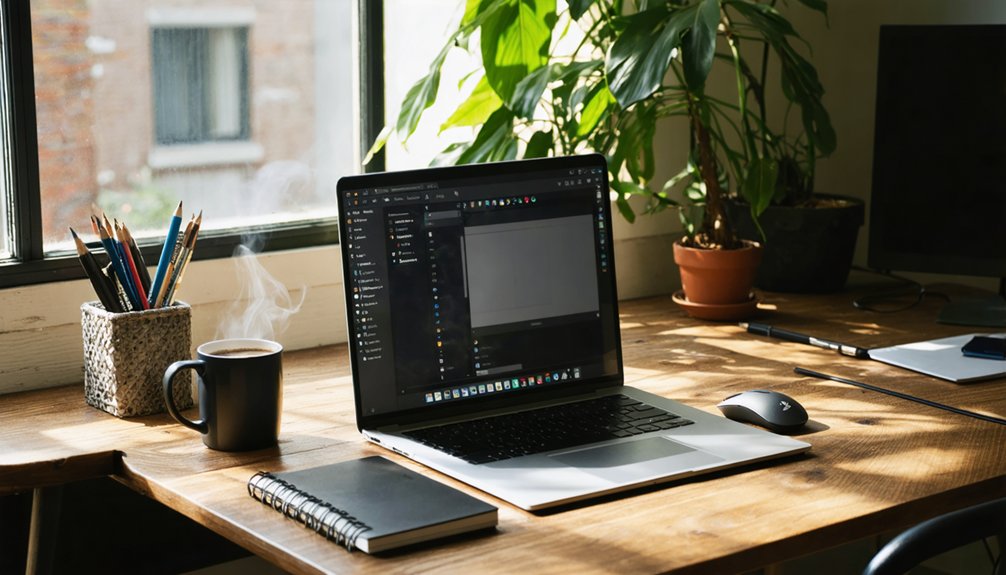

Choosing a laptop for remote work success involves several key factors. Performance requirements include a capable processor, at least 16GB of RAM, and an SSD for quick access to files. Battery life should exceed eight hours to support productivity without interruptions. Display quality and portability are crucial for comfort and efficiency. Connectivity options enhance versatility. Carefully evaluating these criteria guarantees a suitable laptop that meets professional needs. Examine further to uncover detailed perspectives on maximizing your remote work setup.
Highlights
- Prioritize at least 16GB of RAM and a modern Intel or AMD processor for efficient multitasking and performance during remote work tasks.
- Choose a laptop with a high-resolution display for improved productivity and color accuracy, crucial for creative tasks.
- Ensure lightweight construction and robust battery life, ideally over 8 hours, for portability and durability during remote meetings and work sessions.
- Look for enhanced connectivity features like Wi-Fi 6 and multiple ports to seamlessly integrate with peripherals and maintain reliable communication.
- Consider remote work-specific features like a Full HD webcam and noise-canceling microphones for clear virtual interactions and enhanced collaboration.
Performance Requirements for Remote Work Laptops
When selecting a laptop for remote work, understanding performance requirements is crucial for ensuring productivity and efficiency. Users should prioritize a minimum of 16GB RAM, ideally DDR4 running at 3200 MHz, to facilitate smooth multitasking with numerous applications, from video conferencing to document editing. With regard to processor recommendations, the latest Intel Luna Lake or AMD Ryzen 5/7 processors provide reliable performance for everyday tasks, while the Apple M4 Pro chip excels in handling more intensive workflows. For an exhaustive laptop comparison, including storage, fast SSDs with at least 512GB and NVMe capabilities are essential, substantially improving responsiveness. Notably, best laptops for working from home are available on various sites, helping users find the perfect match for their needs. Additionally, laptops should also feature high performance components like dedicated GPUs to ensure they can handle graphic-intensive tasks effectively.
Battery Life Considerations for Extended Productivity
Selecting a laptop for remote work goes beyond performance specifications; battery life stands as a critical factor in maintaining productivity throughout the day. Research indicates that 60% of Americans experience battery anxiety, which can lead to significant productivity loss. As remote work evolves, a minimum of eight hours of battery life is essential for standard tasks, while premium models may offer 18-20 hours, enabling extended mobility. Effective battery management strategies, such as optimizing screen brightness and minimizing video conferencing, enhance power efficiency. With approximately 65% of businesses prioritizing battery capacity, choosing a laptop with sturdy battery performance not only combats battery anxiety but also cultivates a more productive and less stressful work environment for remote professionals. Additionally, having access to power is essential to reducing anxiety and promoting productivity, thus further emphasizing the importance of choosing a laptop with strong battery life. The growing trend of high-capacity batteries in laptop models indicates a significant shift towards longer-lasting performance options that cater to remote work needs. Furthermore, with laptops generating USD 109.1 billion in revenue in 2022, it is clear that manufacturers are adapting to meet the increasing demand for durable and efficient devices in the market. Moreover, laptops with long battery life are highly valued for enabling uninterrupted workflows during virtual meetings and essential tasks. With the lithium-ion battery market for consumer electronics projected to reach $100 billion by 2030, the push for advanced battery technology will continue to enhance the experience for remote workers.
Importance of Display Quality for Visual Tasks
Display quality plays a pivotal role in enhancing productivity, particularly for remote workers engaged in visual tasks. Advanced display technology, including higher resolution options like QHD and 4K, substantially improves productivity metrics. Research indicates that external monitors can yield productivity gains ranging from 31.4% to 43.8%, showcasing that large screens enhance multitasking capabilities. Additionally, color accuracy is essential for professionals who require precise color reproduction for their projects, ensuring the integrity of visual content. Proper display settings, including high contrast and ideal luminance, contribute to visual comfort, reducing fatigue during long work sessions. By prioritizing display quality, remote workers can nurture a more efficient and satisfying working environment, customized to their collaborative and individual needs. Importantly, data suggests that multi-screen setups significantly boost productivity by allowing for simultaneous data display and minimizing context switching. Visual ergonomics is vital to reduce discomfort and enhance productivity during prolonged computer use. Prolonged use of laptops can lead to visual discomfort, making it crucial to choose devices with features that support eye health and comfort. This is particularly relevant as the laptop market is expected to grow by $7.52 billion during 2020-2024, driven by the demand for quality displays in remote work settings.
Portability and Durability for On-the-Go Professionals
For remote professionals, the balance between portability and durability is vital, especially as they move between various work environments. Laptops like the Dell XPS 13 and HP Elite Dragonfly showcase lightweight constructions, typically measuring under 3.5 pounds for easy transport. Ideal portable designs range from 13 to 15 inches, ensuring a comfortable workspace while simplifying bag accommodation. Battery life remains essential; devices like the MacBook Air provide over 8 hours, vital for those working away from power sources. Additionally, aluminum or magnesium chassis enhance durability, with features such as spill-resistant keyboards safeguarding against damage. The number of people working remotely has increased significantly, making these features even more critical for today’s mobile professionals. Notably, laptops such as the Dell XPS 13 offer impressive specifications, further enhancing productivity for remote workers.
These considerations together create a sturdy gadget for mobile professionals, blending function and resilience for successful remote work.
Essential Connectivity and Port Selection
Connectivity stands as a cornerstone of effective remote work, making sturdy wireless options and diverse ports essential features in any laptop. A laptop equipped with dual-band Wi-Fi and supports the latest Wi-Fi 6 standard ensures reliable connections, particularly vital for video conferencing and accessing cloud applications without interruption. Furthermore, a variety of physical ports, such as USB-C and HDMI, enables seamless integration with modern peripherals and external displays, thus enhancing productivity. Organizations should also consider docking solutions, as universal compatibility allows remote workers to easily connect to multiple devices, reducing cable clutter and simplifying their workspaces. Ultimately, attention to connectivity and port selection fosters an inclusive and efficient remote work environment that benefits both employees and organizations alike. As remote work options become more common, equipping laptops with excellent connectivity features is increasingly important. Moreover, with 61% of workers being more productive working from home, having a laptop that supports these connectivity standards can significantly contribute to an effective remote work setup. Given that 28% of employees worldwide worked remotely in 2023, these features are essential for optimizing performance across diverse work environments. Additionally, 40% of job postings worldwide now offer remote or hybrid options, underscoring the need for laptops that cater to modern work requirements.
Remote Work-Specific Features to Enhance Communication
Effective communication is paramount in the domain of remote work, necessitating laptops equipped with specific features designed to facilitate interaction. Laptops featuring Full HD webcams guarantee clarity during virtual meetings, while enhanced microphone arrays with noise cancellation technology substantially improve voice capture. Many business-class models, like those from HP, incorporate integrated communication tools optimized for platforms such as Microsoft Teams, allowing for seamless collaboration. Additional features, like physical privacy shutters and noise suppression, enhance security and focus during calls. High-fidelity audio systems further lift the meeting experience by producing clear sound. Ultimately, selecting a laptop with these remote work-specific features promotes a sense of connection and belonging among distributed teams, enhancing overall collaboration effectiveness. A robust performance capacity is essential to smoothly handle video conferencing and collaborative tasks without lag or interruption. Moreover, laptops with more RAM enable better multitasking, ensuring that applications run smoothly during meetings. Additionally, reliable connectivity options allow remote workers to maintain seamless communication regardless of their location.
Choosing the Right Processor for Your Workload
Selecting the right processor for remote work is critical in ensuring that a laptop meets the diverse needs of professionals.
A thorough workload assessment is essential for effective processor comparison.
For creative tasks like video editing, at least an Intel Core i7 or AMD Ryzen 7 is recommended to handle demanding applications.
Business users may find the Intel Core i7 (11th-13th Gen) offers balanced performance, while entry-level Intel Core i3/i5 processors suffice for basic tasks like document processing.
Emerging options such as AMD’s Ryzen AI 9 HX 370 demonstrate the importance of AI capabilities for enhanced productivity.
Ultimately, choosing the right processor is about aligning specifications with individual job requirements, ensuring both performance and efficiency for a successful remote work experience, and helping professionals to plunge into their work with the right tools.
Assessing RAM and Storage Needs for Multitasking
The performance of a laptop for remote work is not solely reliant on the processor; RAM and storage also play vital roles in multitasking efficiency.
For basic office tasks like email and document editing, a minimum of 8 GB RAM is sufficient, allowing for light multitasking during virtual meetings.
However, for a seamless experience with multiple applications, 16 GB RAM is recommended, especially as cloud computing demands increase.
Those engaged in resource-intensive tasks, such as graphic design or programming, may require 16-32 GB RAM to prevent performance bottlenecks.
Additionally, a solid-state drive (SSD) with at least 256 GB storage enhances data loading speeds and supports rapid application launches, essential for productivity in a remote environment.
Evaluating Manufacturer Claims Against Real-World Performance
Evaluating manufacturer claims against real-world performance is crucial for individuals aiming to select a laptop that meets their remote work needs.
Often, overestimation tactics result in battery life claims that overstate performance by 30-50%.
For instance, while the HP Omnibook X claims 26 hours of playback, independent tests reveal an actual performance of only 15-16 hours.
Manufacturers’ benchmarks, conducted under ideal conditions, fail to account for real usage scenarios involving demanding applications and simultaneous tasks.
Additionally, metrics that promise high-speed bandwidth or quick response times may substantially diverge from practical experience.
Thus, potential buyers should seek third-party reviews and user feedback to establish realistic expectations, ensuring their chosen device aligns with the rigors of remote work, and it is essential to take a closer look.
Budgeting for Your Ideal Remote Work Laptop
Budgeting for an ideal remote work laptop involves careful consideration of various price tiers and the specific needs of the user. Effective budget planning begins with understanding entry-level options under $400 like the Lenovo Chromebook Duet 3, suitable for basic tasks.
Mid-range choices, priced between $500 and $1,000, provide a balance of performance, such as the ASUS Vivobook 16. While premium laptops exceed $1,500, justifying their costs through features like enhanced battery life and resilient security, users must conduct a thorough cost analysis.
Additionally, hidden expenses like adapters and software subscriptions can substantially impact the overall budget. Ultimately, making informed decisions guarantees that users find a device that aligns with their remote work aspirations.
References
- https://www.rtings.com/laptop/reviews/best/work-from-home
- https://www.bestbuy.com/site/shop/best-laptop-for-working-remotely
- https://www.youtube.com/watch?v=gn2Ls8gJsjo
- https://community.screwfix.com/threads/best-laptops-for-business-tasks-and-remote-work.285162/
- https://coincodex.com/article/37015/best-laptops-for-remote-work/
- https://www.hp.com/us-en/shop/tech-takes/essential-remote-work-tools-complete-guide
- https://windowsforum.com/threads/top-10-best-laptops-for-professionals-in-2025-power-portability-performance.371169/
- https://www.hustleinspireshustle.com/blog/best-laptops-to-work-from-home
- https://www.gadgetsalvation.com/blog/the-best-5-laptops-for-remote-workers-in-2025/
- https://www.boxpiper.com/posts/buying-a-computer-for-remote-work-5-things-to-know