

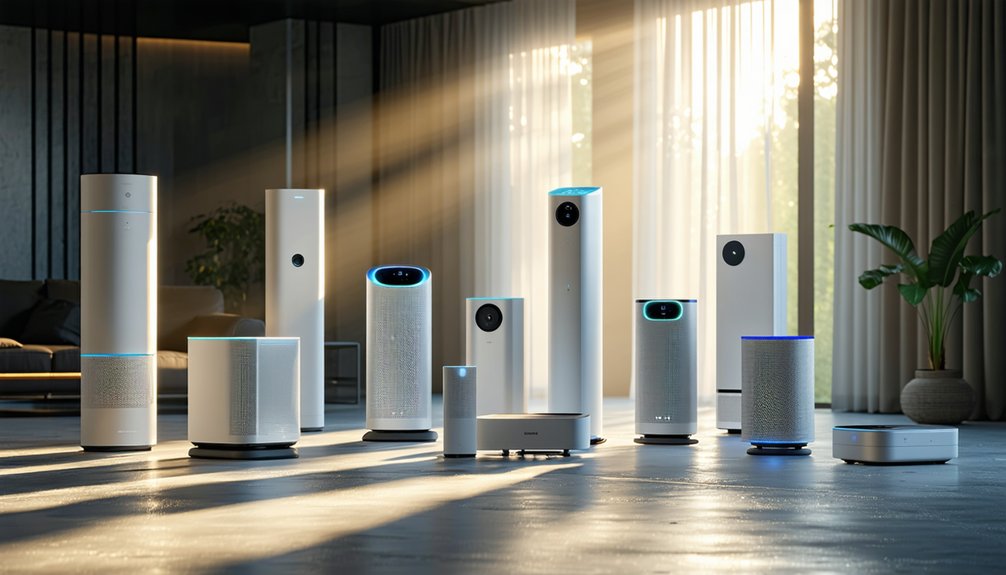

The best air purifiers for dust in 2026 rely on True HEPA filtration, strong CADR ratings, and smart auto-adjustment to stay ahead of airborne particles year-round. Top-ranked models include the Coway Airmega AP-1512HH, Levoit Core 300, Blueair Blue Pure 211+, Honeywell HPA300, and Dyson TP07 — each proven to slash PM2.5 levels by over 96% within an hour. Room size, noise tolerance, and filter costs separate the winners from the rest, and the full breakdown ahead makes choosing one straightforward.
Key Takeaways
- CADR ratings determine real-world dust removal; a 246 CFM rating like Coway’s can improve air quality 96% in 362 sq ft.
- True HEPA filters capture 99.97% of particles at 0.3 microns, making them the gold standard for eliminating dust effectively.
- Honeywell HPA300 strips over 99% of particulate matter in 45 minutes, handling rooms up to 581 sq ft reliably.
- Blueair Blue Pure 211+ removed 98.8% of airborne particulates in one hour using HEPASilent electrostatic and mechanical filtration combined.
- Match CADR to room size; a 120 sq ft room requires at least 80 CFM to achieve adequate dust reduction.
The Best Air Purifiers for Dust in 2026, Ranked
Dust buildup is a relentless household problem, and the right air purifier makes a measurable difference. In 2026, leading brands like Levoit, Philips, and Xiaomi dominate rankings by delivering H13 HEPA filtration with 99.97% particle capture efficiency. These machines don’t just perform — they’re engineered around real-world living.
Noise profiles vary markedly across models. The Philips Serie 600 whispers at 19 dB, while the Rowenta PU2530 runs at 41 dB — both removing harmful particles without compromise. Choosing wisely means matching noise tolerance to environment.
Filter lifespan directly impacts long-term cost and clean-air consistency. Models with multi-stage filtration, like the Membrane Solutions MSA3, extend performance cycles while maintaining output. Smart PM2.5 sensors auto-adjust fan speeds, reducing unnecessary filter strain and preserving system longevity. Beyond dust and particles, units equipped with activated carbon layers effectively deodorize smoke and persistent household odors.
What Actually Makes an Air Purifier Good at Removing Dust?
Not every air purifier handles dust equally — performance comes down to engineering specifics. The real differentiators are HEPA filtration, CADR ratings, and airflow dynamics working together. A unit pushing 586 cfm cleans 879 square feet five times per hour — that’s measurable liberation from dust, not marketing language.
HEPA filters capture 99.97% of particles down to 0.3 microns, while pre-filters catch larger debris first, protecting the main filter’s lifespan. Filter maintenance isn’t optional — neglected filters choke airflow and destroy performance.
Speed matters too. High-performing units show noticeable improvement within 30-60 minutes. Activated carbon handles odors and VOCs alongside dust removal. Room sizing, fan speed, and continuous operation complete the equation. Get these variables right, and dust simply stops winning. Dust itself is a mix of organic matter like dead skin cells and pet dander alongside inorganic particles such as soil and fabric fibers, meaning filtration systems must contend with a genuinely complex blend of debris.
HEPA vs. HEPASilent vs. PECO: Which Catches More Dust?
Once the fundamentals of HEPA filtration, CADR ratings, and airflow are understood, the next question gets more specific: not all HEPA-grade technologies are the same thing.
Standard HEPA physically traps particles — reliable, validated, and straightforward on filter maintenance. HEPASilent adds electrostatic longevity to the equation, capturing the same 0.3-micron particles with quieter operation and less energy drag. For dust, both perform comparably.
The real divergence happens with PECO. Rather than just trapping dust allergens, PECO destroys them at the molecular level — cat dander proteins dropped to 8% remaining versus 92% on standard HEPA. That’s not capturing dust; that’s eliminating what makes dust dangerous. For people done tolerating half-measures, PECO-plus-HEPA combinations offer the most exhaustive dust control currently available. Unlike HEPA or carbon alone, PECO uses oxidation to chemically break down pollutants rather than simply trapping or adsorbing them.
How Room Size Determines Which Air Purifier You Need
Every air purifier recommendation collapses without one critical input: room size. Measure length times width first. A 12×10 room equals 120 square feet — straightforward math that reveals the right CADR minimum. For that space, target at least 80 CFM. For 200 square feet, nothing below 133 CFM qualifies.
Ceiling adjustments matter too. Standard ratings assume eight-foot ceilings. Vaulted or nine-to-ten-foot ceilings demand stepping up to a larger-capacity unit — more air volume means more work.
Placement strategies seal the deal. An undersized unit running at maximum speed still fails a room it cannot handle. Oversized units waste money and generate unnecessary noise. Match coverage to actual square footage, account for ceiling height, and position units centrally. That formula eliminates guesswork entirely. For irregular rooms, divide the space into separate rectangles, measure each section individually, and sum the volumes to get an accurate total cubic volume calculation.
The 5 Features Worth Paying Extra For
Most air purifiers share the same basic promise — cleaner air — but the gap between a budget unit and a premium one comes down to five specific features.
First, multi-stage filtration — HEPA, activated carbon, and pre-filters working together — captures everything from fine particulates to odors.
Second, filter longevity matters; washable components lasting 20 years eliminate constant replacement costs.
Third, real-time PM2.5 monitoring gives instant, actionable feedback.
Fourth, noise mitigation through sleep mode and quiet fan engineering means purification never disrupts rest.
Fifth, smart features — Wi-Fi control, auto mode, eco mode — let the machine handle itself without micromanagement.
These aren’t luxury additions. They’re the difference between a device that genuinely improves daily life and one that simply occupies counter space. Americans spend roughly 90% of their lives indoors, making consistent and effective air purification far more consequential than most people realize.
Coway Airmega AP-1512HH: Best Overall Air Purifier for Dust
The Coway Airmega AP-1512HH earns its top spot through raw performance — a dust CADR of 246–247.7 CFM, enough to improve air quality by 96% in a 362-square-foot room at maximum speed. In testing, it slashed PM2.5 from 113.8 µg/m³ down to 4.7 µg/m³ within 60 minutes.
Its four-stage filtration — pre-filter, True HEPA, activated carbon, and bipolar ionizer — handles everything from pet dander to VOCs. The washable pre-filter extends filter lifespan considerably, while the Max2 filter needs annual replacement at roughly $70.
At speed 2, noise sits at 44.4 dBA — livable. Top speed hits 60.1 dBA, which is louder. Auto mode still delivers 90% air quality improvement without the noise. Under $250, nothing competes at this level. It weighs just 12.7 to 13 pounds, making it easy to move between rooms as needed.
Levoit Core 300: Best Budget Air Purifier for Dust Under $100
Budget-hunters get a lot for under $100 with the Levoit Core 300. This compact unit pulled 96% of particulates from a 12×12 room in one hour, cutting PM2.5 from 83.8 to 5.8 µg/m³ — numbers that embarrass pricier competitors. It even outpaced the Dyson HP04 by 38 minutes in smoke-clearing tests.
The three-stage filtration — pre-filter, True HEPA, and activated carbon — traps 99.97% of particles down to 0.3 microns. For maintenance tips, watch the filter indicator light and stick with genuine Levoit replacements to protect filter lifespan and performance. Optional upgrade filters target VOCs and heavy smoke.
No air quality sensor limits autonomous operation, but for dust, allergens, and budget-conscious buyers, the Core 300 delivers serious results without financial compromise. Those weighing a step up should know the Core 300S costs approximately $33.25 annually to run — roughly 40% less in electricity than the Core 300 — making the long-term savings a meaningful factor in the decision.
Blueair Blue Pure 211+: Best Air Purifier for Large Dusty Rooms
Scaling up from compact budget picks, large dusty rooms demand a different class of machine — and the Blueair Blue Pure 211+ delivers.
Covering 540 square feet, it removed 98.8% of airborne particulates in one hour, dropping PM2.5 to nearly zero. Its HEPASilent technology combines mechanical and electrostatic filtration, with the ionizer alone accounting for a 62% performance boost.
Noise stays under 45 dBA at lower speeds — genuinely livable. Placement strategy matters here: central positioning maximizes its CADR of 350. Filter maintenance stays straightforward, though its size makes repositioning awkward.
No app, no auto mode — just raw, effective performance. For large dusty spaces, that liberation from complexity is exactly the point. The washable pre-filter, available in diva blue and dark shade, extends the life of the particle filter by capturing large debris before it reaches deeper filtration stages.
Dyson TP07: Best Air Purifier for Large Rooms With Smart Features
For large rooms where smart control matters as much as clean air, the Dyson TP07 makes a compelling case. Its HEPA H13 filter captures 99.97% of 0.3-micron particles, while activated carbon handles odors and gases. The fully sealed design guarantees nothing escapes back into the room.
Smart features genuinely earn their place here. The MyDyson app enables remote diagnostics, tracking air quality in real time through graphs and live feedback. Auto Mode handles energy optimization automatically, pausing when target air quality is reached and adjusting fan speeds based on detected pollutants.
With 350° oscillation, 10 speed settings, Night Mode, and compatibility with Alexa, Siri, and Google Home, the TP07 delivers serious purification without demanding constant attention. Priced between $408–$579, it rewards the investment. The unit is Energy Star Certified, confirming its efficiency credentials for those running it around the clock.
Honeywell HPA300: Best Air Purifier for Dust and Allergies
Allergy sufferers dealing with dust, pet dander, and pollen have a reliable workhorse in the Honeywell HPA300. It strips over 99% of particulate matter in 45 minutes and handles rooms up to 581 square feet — no guesswork needed.
Three True HEPA filters plus an activated carbon pre-filter tackle allergens and VOCs simultaneously. Filter lifespan costs roughly $91.75 annually, which is manageable without breaking the budget. Setup takes five minutes flat.
Fan noise is the honest tradeoff here. Turbo mode hits 55 decibels — noticeable but livable. Lower settings run quietly enough to blend into background sound. No Wi-Fi, no auto mode — just straightforward, Energy Star-certified performance that consistently outperforms competitors in allergen and odor reduction testing. With 4.8 air changes per hour in a 465 square foot room, the HPA300 is AHAM Verifide for consistent, measurable cleaning performance.
References
- https://airpurifier.guru
- https://www.market.com/heating-cooling-air-quality/air-purifiers/overall/
- https://www.consumerreports.org/appliances/air-purifiers/best-air-purifiers-of-the-year-a1197763201/
- https://www.rtings.com/air-purifier/reviews/best/air-purifiers
- https://www.housebeautiful.com/shopping/home-gadgets/g70758440/best-air-purifiers-2026/
- https://www.blueair.com/collections/consumer-reports
- https://www.youtube.com/watch?v=GW00AkrcsdY
- https://www.elconfidencial.com/decompras/hogar/2026-03-02/mejor-purificador-aire_2094258/
- https://www.elindependiente.com/de-tiendas/2026/03/09/mejor-purificador-de-aire/
- https://www.elconfidencialdigital.com/articulo/electrodomesticos/mejores-purificadores-aire-ocu/20250303144848937256.html