

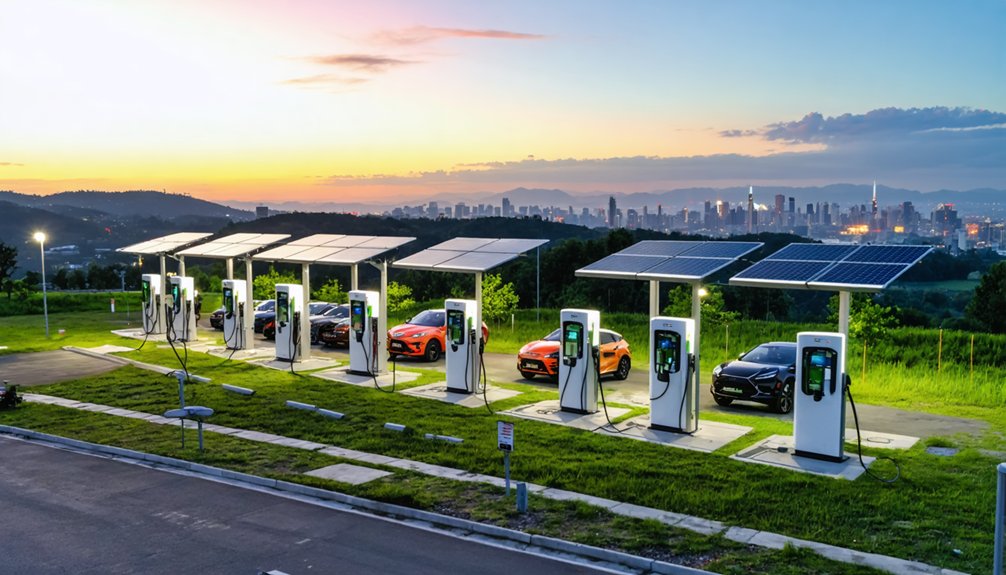

The expansion of EV charging infrastructure in the U.S. is on a robust upward trajectory, with over 11,600 stations and nearly 60,000 ports available. This growth is driven by an increase in electric vehicle demand and technological advancements, particularly in fast charging capabilities. Geographic disparities persist, with urban areas enjoying more access than rural locales. Initiatives are underway to ensure equitable access for all communities. Further insights reveal the ongoing strategies shaping this evolving landscape.
Highlights
- The U.S. currently has over 11,687 charging stations, with a significant year-over-year growth projected, especially for DC fast charging ports by 2025.
- Expansion of charging infrastructure focuses on both urban and rural areas, aiming for equitable access to support diverse communities.
- DC fast charging stations provide rapid recharging, with new technologies like the Megawatt Charging System enhancing efficiency and accessibility.
- Public and private partnerships are optimally leveraging resources to accelerate the deployment of charging networks across various regions.
- Future projections indicate a need for 1 million additional public chargers by 2030 to meet the rising demand for electric vehicles.
Current State of EV Charging Infrastructure in the U.S
As the demand for electric vehicles (EVs) continues to rise, the current state of EV charging infrastructure in the United States has become a critical factor in supporting this shift. The nation boasts 11,687 stations and 59,694 ports, including both public and private charging facilities. Charging options range from Level 1 to DC Fast Charging (DCFC), with the latter offering the quickest refueling times. Despite the extensive network, station maintenance can lead to temporary unavailability of certain chargers, impacting overall accessibility. Additionally, temporarily unavailable stations can interrupt service during maintenance, which can affect users’ charging experiences. Charging costs are becoming more predictable, helping to promote consumer confidence. As the EV market expands, this growing infrastructure not only meets present needs but also paves the way for future electric mobility, nurturing a community of eco-conscious drivers and supporting a forecasted growth of 16,700 new fast charging ports in 2025. Furthermore, the infrastructure growth has been remarkable, with the U.S. adding 780 public high-speed EV charging stations in just the third quarter alone. This significant growth is crucial to support the nation’s goal of having 540,000 chargers by 2025.
Recent Growth Trends in Charging Station Deployment
While the demand for electric vehicles accelerates, the expansion of charging station deployment has emerged as a key trend in the U.S. market. Growth patterns indicate a vigorous trajectory, with projections suggesting a record year for DC fast charging in 2025, anticipating a nearly 20% year-over-year increase. Deployment strategies are developing, driven by innovative “Charging 2.0” companies that are prioritizing the establishment of larger and more reliable stations. Remarkably, the average ports per station rose substantially, reflecting a shift toward higher density in non-Tesla networks. With enhanced reliability metrics alongside infrastructure expansion, the promise of 540,000 chargers by 2025 emphasizes a commitment to supporting electric vehicle adoption and nurturing a connected community of environmentally conscious drivers. Additionally, a 19% increase in year-over-year port deployment across the U.S. is predicted in 2025, showcasing the flourishing growth of the charging landscape. As reliability in charging stations improves, customers can expect a better overall experience, further driving EV adoption. Notably, public charging stations have increased from 2019 to 2024, but more are still needed to meet the growing demand.
Types of EV Charging Stations Available
The scenery of electric vehicle charging is diverse, offering various station types customized to meet different needs and convenience levels. Level 1 stations use standard 120-volt outlets, providing basic charging ideal for home use, while Level 2 stations, operating on 240-volt services, boast faster charging capabilities, making them common in public spaces like retail centers. Additionally, AC chargers primarily cover home charging, ensuring accessibility for EV owners. Direct Current Fast Charging Stations revolutionize the experience, providing a rapid charge in just 20 minutes to an hour, strategically located along highways. Moreover, non-profit organizations that install and operate these charging stations may benefit from property tax exemptions, enhancing their ability to serve the community. Furthermore, charging standards ensure compatibility and reliability among different EV models, helping to alleviate concerns for potential users about the charging process. Notably, Level 2 charging is more energy efficient than Level 1 charging, allowing for quicker and more economical charging solutions. Meanwhile, networked charging systems incorporate sophisticated Charging Technology and advanced Station Design, enabling detailed usage tracking and various payment options. Together, these options enhance the charging terrain, promoting a sense of community and belonging for electric vehicle users nationwide, while helping to cultivate an environment that will encourage people to take the plunge, or rather, leap into electric vehicle ownership.
Future Infrastructure Requirements for Sustainable Growth
To achieve sustainable growth in the electric vehicle (EV) sector, an extensive expansion of charging infrastructure is imperative. The National Renewable Energy Laboratory forecasts a need for around 1 million additional public chargers by 2030, including a significant increase in DC fast chargers to accommodate the projected influx of 33 million EVs. This expansion must prioritize grid integration, ensuring reliable service while promoting sustainable development. Additionally, infrastructure must be equitably distributed, addressing gaps particularly in rural and underserved communities. With next-generation standards like the Megawatt Charging System and smart grid technologies, the sector can meet diverse charging needs while enhancing grid stability and supporting a green future for all. Furthermore, charging infrastructure must grow alongside EV adoption to maximize its benefits for reducing heat-trapping pollution. EV charging standards ensure safe and efficient charging experiences, which is essential for building public trust in the growing EV infrastructure. Additionally, DC fast chargers can charge an EV up to 80% in just 20-30 minutes, making them a critical component for long-haul routes to be viable for heavy-duty electric trucks. Prioritizing these requirements promotes a sense of belonging in a sustainable EV ecosystem, and also, infrastructure development must be planned to plunge into the needs of a green transportation system, and support a sense of community in a sustainable EV ecosystem.
Geographic Distribution of Charging Stations
As the electric vehicle (EV) market continues to grow, understanding the geographic distribution of charging stations becomes essential for ensuring equitable access to charging infrastructure. Currently, significant regional disparities exist, with the West Coast — particularly California — boasting the highest density of charging stations. In contrast, the middle of the country grapples with substantial coverage gaps that hinder EV adoption. Socioeconomic factors further complicate this terrain; communities of color and lower-income households face heightened challenges in accessing charging infrastructure. Urban areas enjoy greater availability compared to rural locations, underscoring the need for strategic investments and policy support aimed at leveling the playing field. The more than 65,000 public charging locations available nationwide provide a crucial backbone for expanding access, but targeted efforts are required to overcome existing barriers. Furthermore, as public investment in EV charging infrastructure continues to grow, addressing these disparities is vital to promote broader access and nurture a sense of belonging in the EV community.
Expansion of DC Fast Charging Capabilities
With the geographic distribution of charging stations highlighting critical access disparities, expanding DC fast charging capabilities emerges as a necessary focus area.
As of mid-2025, the U.S. boasts over 60,000 public DC fast charging ports, marking a staggering 23% increase in just one quarter alone. Charger upgrades have frequently included powerful installations with output levels between 350-400 kW, enabling faster vehicle charging. Particularly, major providers like Tesla and ChargePoint are driving port expansion by opening new stations or enhancing existing ones, resulting in a significant increase in overall network reliability. Furthermore, the industry is expecting a 19% year-over-year jump in port installations by 2025.
Forecasts from the National Renewable Energy Laboratory stress the urgency for accelerated infrastructure development, as approximately 170,000 new chargers are needed to support the anticipated rise in zero-emission vehicles by 2030.
Addressing Equitable Access to Charging Infrastructure
Equitable access to electric vehicle charging infrastructure remains a critical concern as disparities continue to exist across various communities.
Disadvantaged communities often experience significant barriers, with 64% fewer public EV charging stations per capita compared to their more affluent counterparts.
Moreover, the gap widens to 73% for renters in these areas, highlighting the intersection of socioeconomic factors and environmental justice.
Community engagement initiatives play a crucial role in addressing these inequities, ensuring that voices from underrepresented demographics are heard in the planning and implementation of charging infrastructure.
Policy structures must prioritize equitable access to create a fair distribution of resources, ultimately nurturing a sense of belonging and supporting the shift to electric vehicles for all populations.
Urban vs. Rural Charging Station Accessibility
The disparities in electric vehicle charging infrastructure extend not only between socioeconomic communities but also between urban and rural areas.
While 76.5% of metropolitan counties boast at least one fast EV charging port, only 45% of rural counties share this advantage, underscoring significant rural disparity.
Urban regions contain approximately 90% of all U.S. charging stations, leading to a stark contrast in charging equity.
Despite a 34% growth rate in rural charging infrastructure, metropolitan areas outpace rural developments in absolute numbers.
This imbalance hampers EV adoption in rural settings, creating a cycle where limited infrastructure discourages EV ownership, further delaying investment.
Addressing these gaps is crucial to ensuring equitable access to charging solutions for all communities.
Challenges in Meeting Future Charging Demands
A critical challenge facing the expansion of electric vehicle (EV) charging infrastructure is the need to meet future demand, which is rapidly outpacing current development efforts.
Financial constraints exacerbate this issue, as many Charging Point Operators (CPOs) struggle to achieve return on investment amid rising equipment costs.
Additionally, regulatory obstacles complicate the deployment of charging networks, with inconsistent state regulations and lengthy permitting processes delaying infrastructure rollout.
The projected increase in EVs on the road has also created a demand-supply mismatch, leading to a pressing need for more fast-charging ports.
Without addressing these challenges, the goal of an extensive charging network may remain unattainable, hindering the seamless shift to sustainable electric transportation for everyone.
Opportunities for Targeted Infrastructure Investments
Targeted infrastructure investments present a vital opportunity for enhancing the electric vehicle (EV) charging scenery.
By leveraging innovative investment strategies, stakeholders can effectively employ various funding models, including government subsidies and tax incentives, to substantially lower equipment costs for charging station operators.
For instance, California’s $1.4 billion commitment and New York’s $60 million investment underline the importance of strategic geographic expansion into underserved markets.
Public-private partnerships are essential to optimize operational efficiency, facilitating rapid deployment of high-power charging networks.
Additionally, technological advancements like ultra-fast charging and smart systems promise to streamline energy use.
As the EV market continues to grow, enhancing charging infrastructure through targeted investments will promote broader accessibility and nurture sustainable transportation.
References
- https://www.greencars.com/greencars-101/how-many-ev-chargers-are-there-in-the-u-s
- https://evchargingstations.com/chargingnews/largest-dc-fast-charging-networks-in-the-us-july-2025/
- https://www.latimes.com/environment/story/2025-10-09/the-us-is-adding-ev-chargers-at-a-record-pace
- https://driveelectric.gov/stations-growth
- https://www.climatecentral.org/climate-matters/electric-vehicle-charge-up
- https://afdc.energy.gov/data/10964
- https://www.paren.app/reports/state-of-the-industry-report-us-ev-fast-charging-q2-2025
- https://www.korewireless.com/blog/ev-charging-statistics/
- https://www.statista.com/statistics/416683/leading-electric-vehicles-regarding-charging-time/
- https://www.paren.app/blog/paren-q2-2025-us-ev-charging-report-record-deployment-pace-larger-and-more-reliable-stations-but-utilization-risks-emerging